
How to Choose the Right Air Duct Cleaning Company in New Bedford
Any HVAC company can add “duct cleaning” to its service menu. The real question isn’t whether a company offers it. It’s whether the machine they bring to your house generates enough negative pressure to actually pull debris out of a 25-foot trunk line run. That single detail separates a genuine duct specialist from a generalist holding a brush attachment. So instead of comparing star ratings and coupon prices, here’s the technical checklist we’d want a New Bedford homeowner to use before booking anyone.
Ask These Three Equipment Questions Before You Book
The answers tell you almost everything about the quality of the job you’re buying. A company that hesitates on any of these is telling you something.
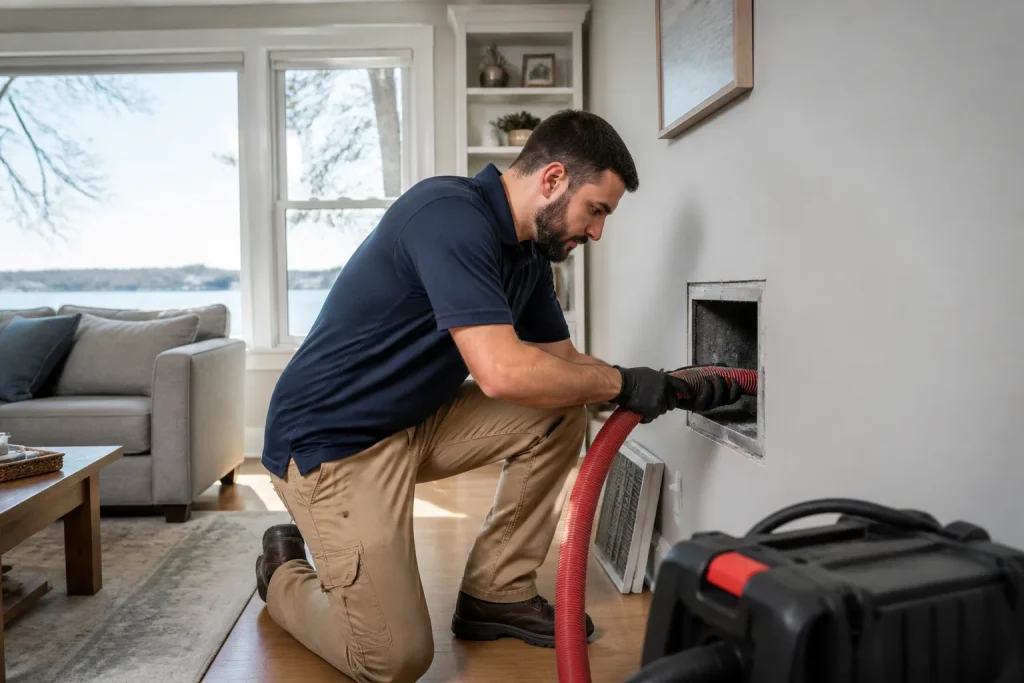
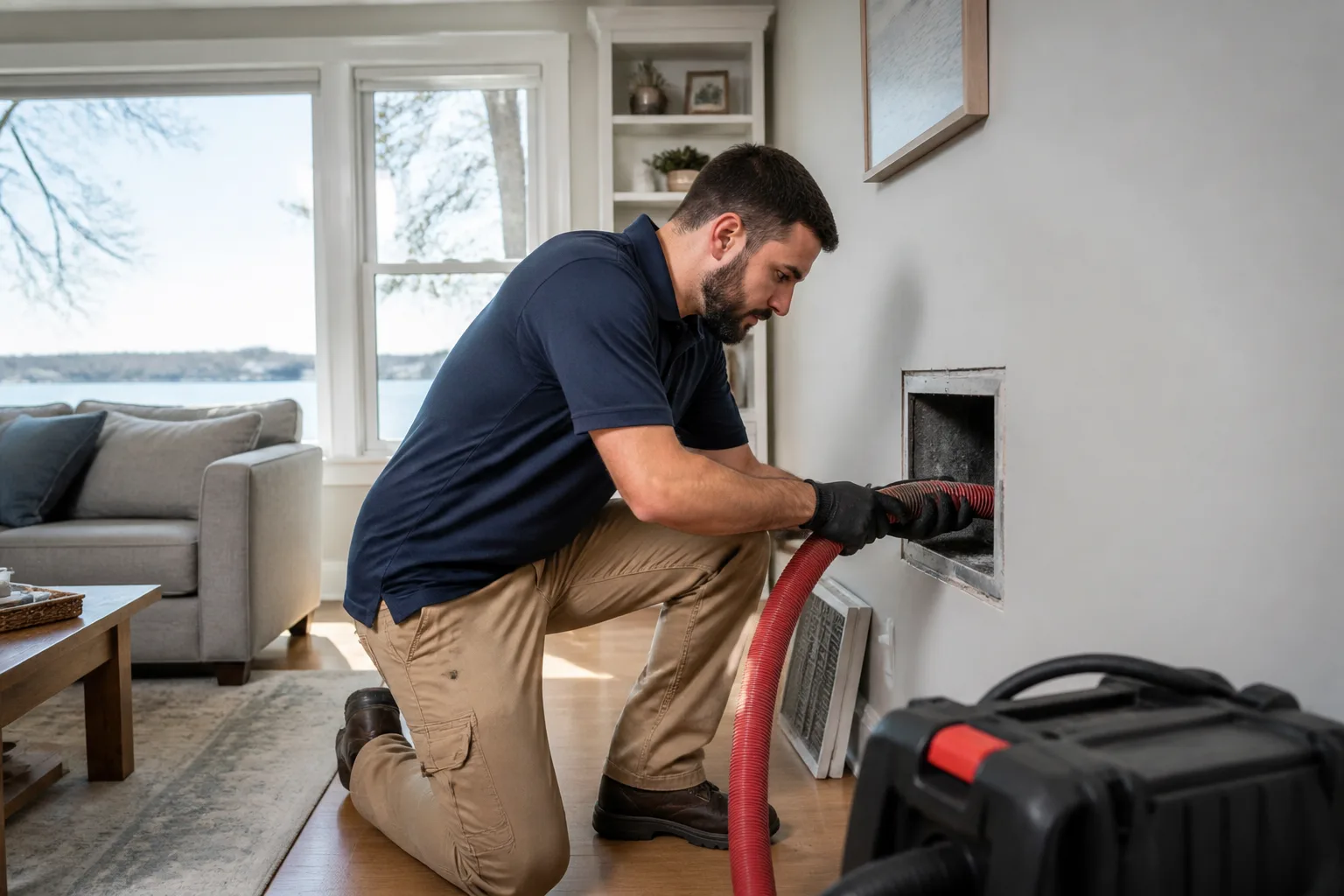
- “What’s the CFM rating of your vacuum unit?” CFM means cubic feet per minute, and it’s the measure of how much air the machine can move. Duct cleaning works by creating negative pressure inside the system so loosened debris travels toward the vacuum instead of settling back into the ducts or drifting into your living room. A unit with a weak CFM rating simply can’t pull material through a long supply run. Professional rigs from Rotobrush and Nikro are built for this. A shop vac on a hose is not.
- “Do you use rotary contact cleaning or air-sweep agitation?” Rotary contact cleaning uses a spinning brush or whip to physically dislodge debris from duct walls while the vacuum holds negative pressure. Air-sweep alone relies on air movement to stir things up, and on heavily soiled systems it often leaves the sticky stuff behind. A serious operator uses contact methods and can explain when each is appropriate.
- “Is your equipment truck-mounted or portable?” Either can work, but the answer should come with a reason. Portable units need enough power to maintain pressure over a long run. If the crew can’t describe how their setup holds negative pressure through your system’s layout, they haven’t thought about it.
One more question worth asking: which equipment brands do they run. We use Rotobrush and Nikro systems because they’re the same brands trusted by professional remediation contractors. That’s not a sales line, it’s a shorthand for how the machine is built and what it can do.
Is NADCA Membership Enough? What the Standard Really Covers
NADCA membership is a useful floor, not a ceiling. It signals that a company operates under an industry framework and has committed to a recognized standard for how duct cleaning should be performed. That matters. But membership by itself doesn’t guarantee that your specific job gets documented, verified, or finished to a specialist level.
What separates a genuinely specialist operation comes down to process:
- Pre-job assessment: a walkthrough of the system before anyone quotes a price, so the scope reflects what’s actually there.
- Post-job verification: before-and-after photos of your own ducts, not stock images pulled from a manufacturer’s gallery.
- Process documentation: a written scope that states what was cleaned and how, so the work can be checked.
- System-level thinking: an awareness that the air handler, blower compartment, and coil area affect duct performance, not just the visible registers.
Ask any prospective company how they document the job before and after. A specialist will have a ready answer. A generalist who does duct cleaning as an add-on usually won’t.
How to Read a Quote: What a Real Scope of Work Includes
A legitimate duct cleaning quote reads like a job specification, not a flyer. If the paperwork you receive is a single line item with a dollar figure, that’s a problem. In our experience, a real scope of work for a New Bedford home should state, at minimum:
- Register count. The number of supply and return registers being serviced, spelled out.
- Supply and return sides identified separately. They’re different runs with different debris profiles. A quote that lumps them together is hiding the work.
- Whether the air handler and blower compartment are included. This is where a lot of dust and biological growth sits, and it’s frequently left out of cheap quotes.
- Duct material. Sheet metal, flex duct, and rigid fiberglass board all need different handling. A company that hasn’t looked at yours can’t quote accurately.
Get the quote in writing. Then check that the scope matches the price. And ask whether air duct cleaning at that price includes an inspection of the ductwork itself. Compromised runs – crushed flex, disconnected joints, torn insulation – let debris and air leak out even after cleaning. We clean it, and if it’s broken, we fix it, which is why duct repair sits alongside cleaning in our service menu rather than behind it.
What happens when you call
- 1
A real person answersNo phone trees – you reach a local pro.
- 2
You get an upfront price rangeHonest numbers before anyone is dispatched.
- 3
A background-checked tech heads outLicensed & insured, dispatched right away.
- 4
You approve before work beginsNothing starts until you say go.
Specialist or HVAC Generalist? Why the Service Menu Matters
An HVAC generalist who offers duct cleaning is usually focused on equipment installation and repair. Duct cleaning is a side service, performed with whatever rig the company happened to buy. A specialist invests the other way around: the cleaning equipment is the core asset, the technicians are trained specifically on it, and the service menu stays tight.
That focus has real consequences for your job. A dedicated operator knows the difference between agitation methods on different duct materials. They carry the right protective products, including the Guardsman line, to protect surfaces and systems during service. They understand that in older New Bedford housing stock, flex duct is common in retrofit runs and needs gentler handling than rigid sheet metal. A generalist crew may know HVAC systems deeply but see your ducts a few times a year at most.
None of this is an argument against general HVAC companies. It’s an argument for matching the provider to the task. When the task is cleaning a duct system, the operator who does it every working day is the one whose process has been refined by repetition.
Red Flags to Watch for in New Bedford
Most bad duct cleaning experiences trace back to the same handful of warning signs. Watch for them:
- Vague per-vent pricing with no job cap. A low teaser rate that climbs once the crew is on site is bait-and-switch. Ask for a flat price per system agreed before work starts.
- Crews who can’t explain negative pressure. If the person on the phone can’t describe how their equipment keeps debris from blowing back into the house, the job isn’t well understood by the people selling it.
- Quotes without a site walkthrough. A duct system’s condition can’t be assessed over the phone. Any quote delivered without an assessment is a guess dressed up as a price.
- No repair capability. If the crew finds a crushed run or a disconnected joint, can they fix it, or do they clean around the problem and leave?
- No dryer vent service. Dryer vents carry a documented fire risk, and a duct specialist should treat them as a safety service, not an upsell.
We take dryer vent cleaning seriously as its own service, for exactly this reason. If your system involves forced-air equipment from brands like Honeywell or Aprilaire, ask whether the company can work with those components too – a specialist should be able to recommend and service whole-home air quality parts, not just clean the ducts around them.
When to Call a Pro (and When to Wait)
Not every dusty register means the system needs cleaning. If you’re seeing visible debris blowing out of supply vents, noticing musty odors when the system kicks on, or you’ve just moved into a home with an unknown service history, it’s worth a call. If you or someone in the house has allergies that seem to spike when the heat or AC cycles, that’s also a signal. On the other hand, a lightly used system in a newer home may not need anything.
If you’d rather not spend a day crawling through a crawlspace with a flashlight – fair, most people wouldn’t – call (844) 793-0706 for a free estimate. We answer 24/7. Fast dispatch from 7am to 7pm, Sunday through Friday. We’re closed Saturday.
Related services in New Bedford: dryer vent cleaning for the fire-risk side of your system, and New Bedford for everything else we do locally. You can also start from our main duct cleaning New Bedford page if you’re just getting oriented.
The Bottom Line
The right duct cleaning company in New Bedford is the one that can answer equipment questions in specifics, quote a full scope of work in writing, document the job with before-and-after photos of your own ducts, and fix compromised ductwork when they find it. Reviews and price matter, but they’re filters, not the whole decision. Contractor-grade equipment and a documented process are what actually protect your investment, and a flat price per system agreed before work starts is what protects your wallet.
If you’re in New Bedford and need help, Duct Cleaning New Bedford offers free estimates – call (844) 793-0706. Our technicians have up to experience, we work with Rotobrush and Nikro systems and Abatement Technologies equipment for elevated indoor air quality scenarios, and we’ll show you what we found before and after the work.
Frequently Asked Questions
Ask three questions: their CFM rating, whether they use rotary contact cleaning, and whether they can produce a written scope with register count and supply/return sides listed separately. A legitimate company answers all three without hesitation and quotes only after a site walkthrough.
No, membership isn’t required. It’s a useful indicator that a company operates under an industry standard, but it’s a floor, not a ceiling. Process documentation, post-job verification, and equipment capability tell you more about the specific job than membership alone.
Usually because the scope is smaller than it appears. Low quotes often leave out the air handler, lump supply and return runs together, or use per-vent pricing that grows on site. Insist on a flat price per system, agreed before work starts, and compare the written scope rather than the headline number.
Some can. Cleaning and repair are separate skills, and a specialist should be able to identify crushed flex, disconnected joints, and torn insulation during cleaning and fix them. If a company can only clean, ask what happens when they find damage – and get the answer before you book. Call (844) 793-0706 for an exact quote. Estimates are free.
Written by the team at Duct Cleaning New Bedford.
Need Air Duct Cleaning Help?
Call Duct Cleaning New Bedford - licensed & insured, with free written estimates in New Bedford.
(844) 793-0706